TRIO.BAS GENIUS SYSTEM
Photo TRIO.BAS GENIUS SYSTEM Description of TRIO.BAS GENIUS SYSTEM FAQs about TRIO.BAS GENIUS SYSTEM Video TRIO.BAS GENIUS SYSTEM Specifications TRIO.BAS GENIUS SYSTEM Prices for TRIO.BAS GENIUS SYSTEM User Manual for TRIO.BAS GENIUS SYSTEM Related instruments to TRIO.BAS GENIUS SYSTEM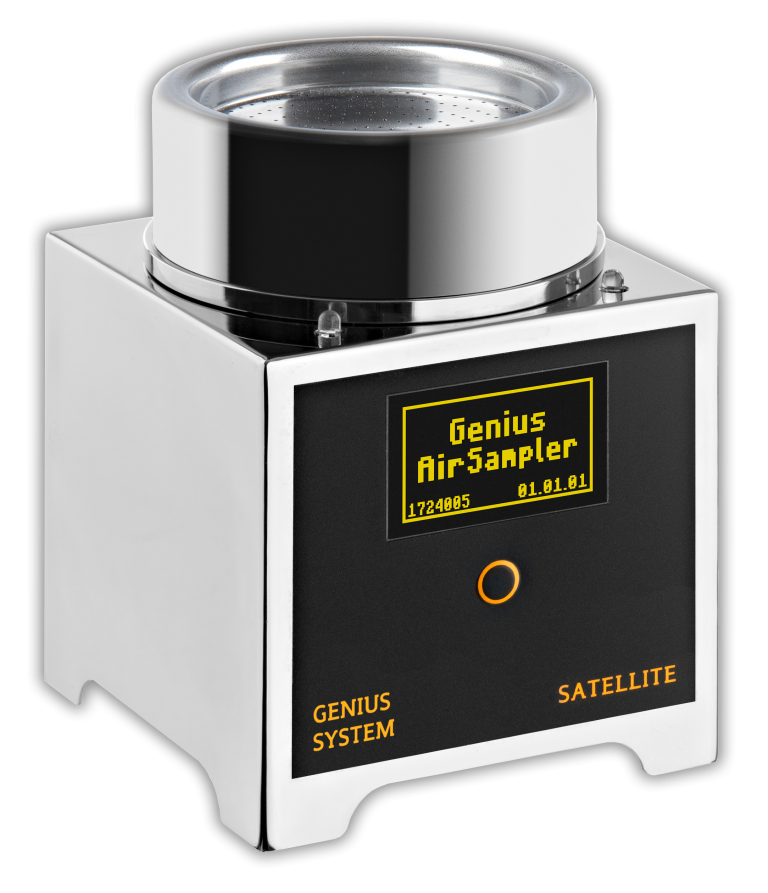
Key features:
Intended use: A modular system for continuous microbiological air monitoring in cleanrooms and sampling at multiple points in the production process. Designed for applications where monitoring is organized in accordance with GMP Annex 1 requirements and risk assessment. Extended sampling periods allow less frequent replacement of Petri dishes and reduce operator interventions.
Made in Italy. brand TRIO.BAS, model GENIUS SYSTEM
International delivery to United Arab Emirates, Kuwait, Qatar, Saudi Arabia, Saudi Arabia, Bahrain, Oman and other Middle Eastern countries.
Our warehouses are located in UAE. Delivery to other countries (Europe, North and South America, Asia, Africa) is discussed individually.
Retail price from $4 046

Available

Only the best I&C brands
Our company is a UAE supplier of control and measuring instruments from well-known world brands

Discounts for organisations
We sell high-tech equipment at best prices. We provide really advantageous conditions for partners

Fast delivery across the Middle East
Supply to United Arab Emirates, Kuwait, Qatar, Saudi Arabia, Bahrain, Oman and other countries

Professional advice on device selection
Our specialists are ready to advise you on any technical question. We can find an analogue of any device
The GENIUS SYSTEM is a microbial air sampling modular system consisting of multiple satellites controlled by a PC tablet with dedicated software. Up to 24 satellites can be connected to one system, each of which can sample different volumes and in different modes, with different flow rates and programs.
The last GMP ANNEX 1 introduced a significant change in microbiological air monitoring in class A and B areas. In these areas, microbiological air sampling must be conducted continuously for the entire duration of the production process, including the preparation of equipment for aseptic operations. For class B areas, this approach is considered according to risk assessment. The GENIUS SYSTEM provides a solution for continuous monitoring at multiple sampling points in the production process.
Unlike the TRIO.BAS RABS ISOLATOR or TRIO.BAS MULTIFLEX, which feature one command unit and a maximum of 3 satellites with common settings, the GENIUS SYSTEM replaces the command unit with a PC tablet with dedicated software.
Benefits and key features of the GENIUS SYSTEM
Who should choose the GENIUS SYSTEM?
The GENIUS SYSTEM satellites run independently from the others. Each satellite can sample different volumes and in different modes, according to its individual sampling program, duration and operating settings. The operator can disable one or more satellites without any impact on the other satellites’ features: each satellite continues to run its own program.
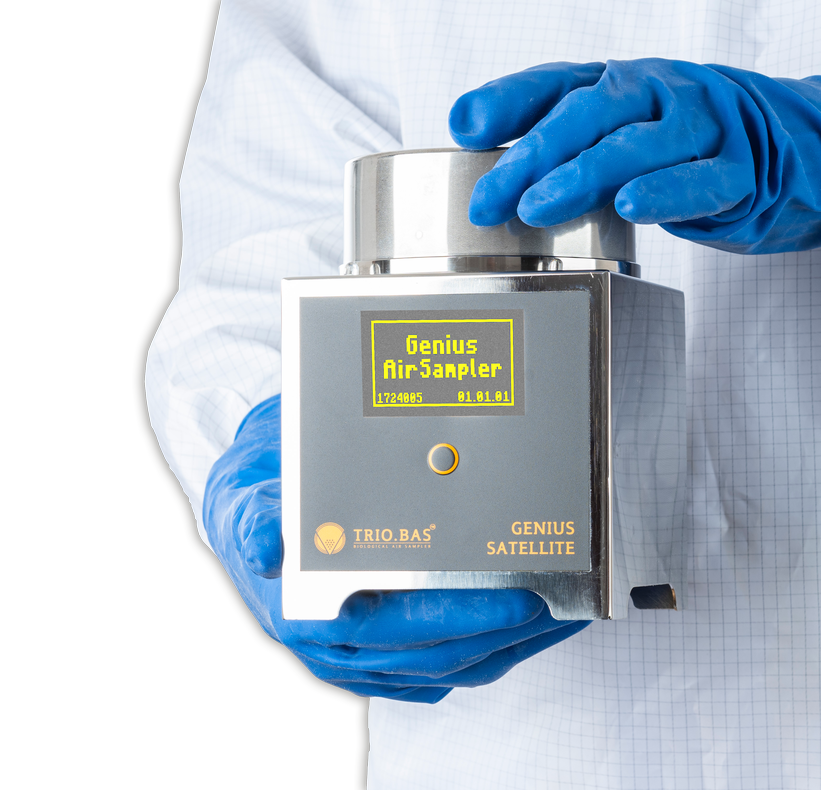
The pump is integrated, so no external pump or command unit is required. All the essential components are built into a compact stainless steel housing. The sampling head measures approximately 10 × 10 × 10 cm, making it suitable for environments where space is limited, including isolators.
The satellites are connected to the PC tablet via a cable. The OLED display shows the steps of the sampling cycle directly on each satellite. The modular configuration allows sampling at multiple points in the production process. The number and positioning of the satellites are determined according to the equipment configuration, process requirements and risk assessment.
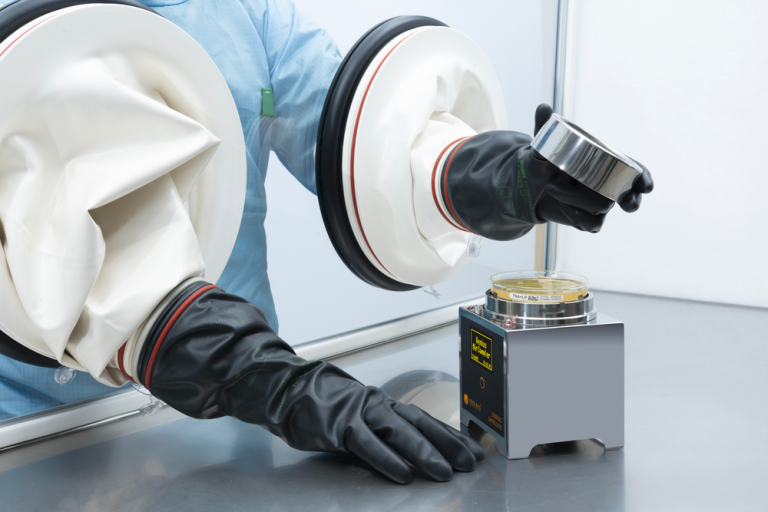
Each satellite is provided with an HEPA filter to filter the output air. During system installation, its impact on airflow must be considered, and the selected configuration must be justified as part of the Contamination Control Strategy (CCS). The output air is directed along the airflow to minimize turbulence. The GENIUS SYSTEM satellites can also be combined with remote systems. In this configuration, the sampling point is located inside the isolator while the agar plate remains outside, saving space inside the isolator and eliminating the need to handle the agar plate through glove ports.
The stainless steel satellites can remain in place during isolator decontamination with vaporized hydrogen peroxide (VHP). The aspirating chamber allows sterilization with vaporized hydrogen peroxide (VHP).
BAS Software provides control of the GENIUS SYSTEM satellites, including parameter settings, assignment of sampling programs, and the start and monitoring of sampling cycles. The software and satellite displays show the status of the devices and the progress of the sampling cycles. This allows the operator to check that monitoring is being performed at each sampling point.
BAS Software is stated to comply with the requirements of 21 CFR Part 11 for electronic records and electronic signatures. Features include user identification by username and password, access control according to user profiles, an audit trail of all records, electronic signatures to confirm authorship, and the storage of data and results in protected files for report generation. The CFU Photo Camera (code 337), connected to a PC running BAS Software, is available for photographic recording of results. The software saves photographs of the agar plate immediately before and after manual colony-forming unit (CFU) counting. Images are saved automatically. Detailed information about an individual sample can be exported to PDF or printed.
The GENIUS SYSTEM can be integrated into existing isolators and RABS. The compact housing with an integrated pump, the absence of a separate command unit, a single M12 connector for power and data transmission, and the possibility of using a remote aspirating head allow the system to be adapted to different equipment configurations.
Connecting and positioning the satellites
The standard connection cable is 5 m long. Cables with lengths of 20 m and 25 m are also available. The PC tablet can be positioned outside the classified area, allowing the operator to control multiple sampling points.
Each satellite operates on a DC power supply of 18–36 V and draws 500 mA. Power and data are transmitted through a single 4-pin M12 male connector. The Modbus RS485 protocol is used for data communication. Modbus RS485 can be considered for integration with building management systems (BMS), supervisory control and data acquisition systems (SCADA), and laboratory information management systems (LIMS). Interface parameters are determined according to the system used.
Examples of system configurations
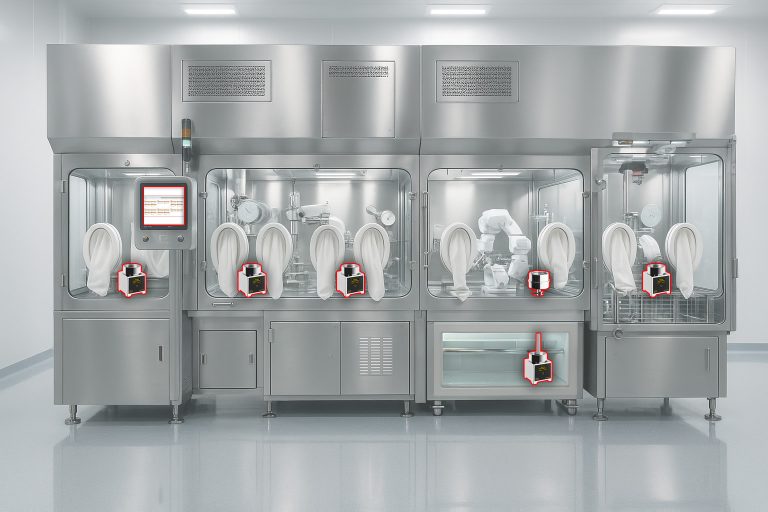
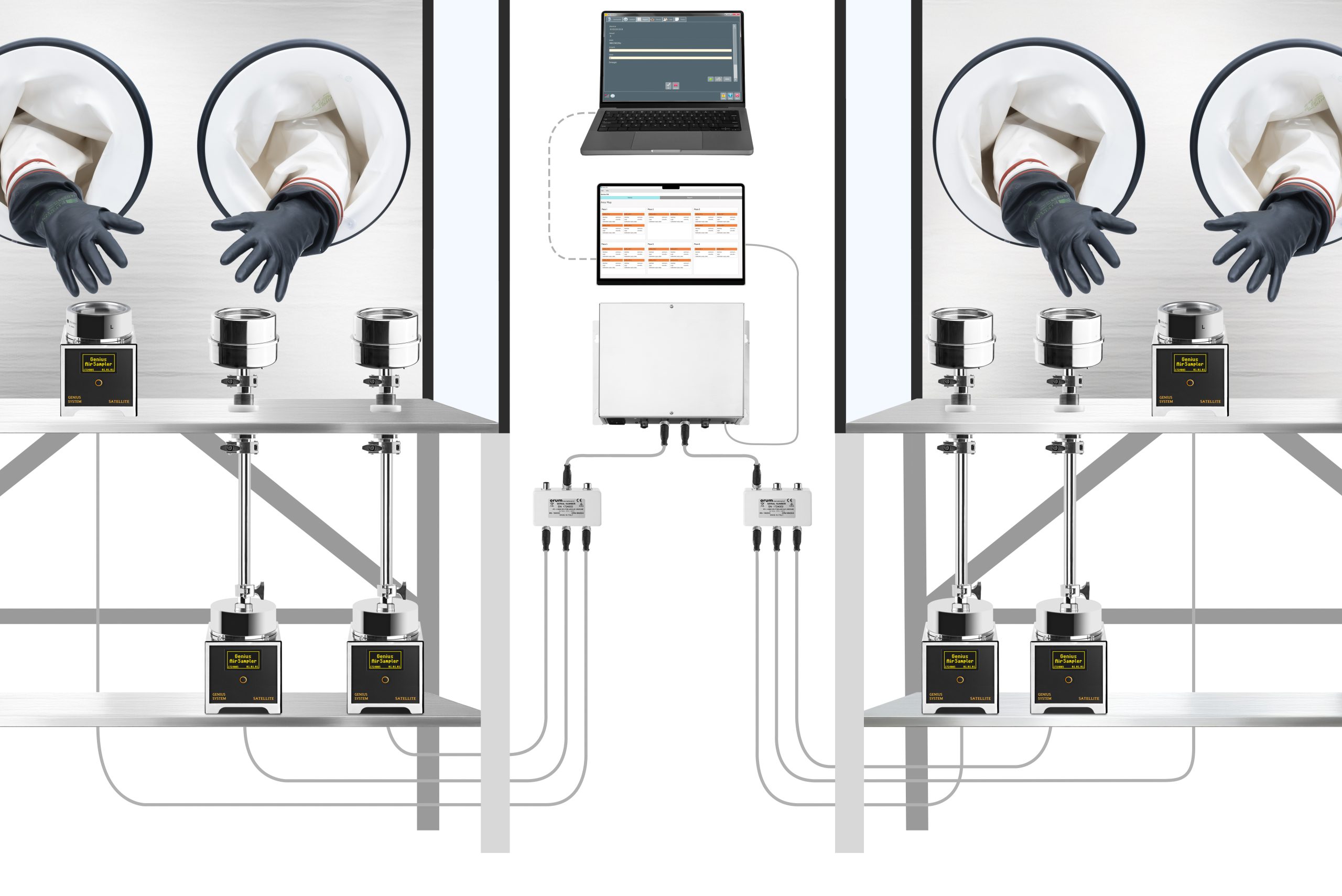
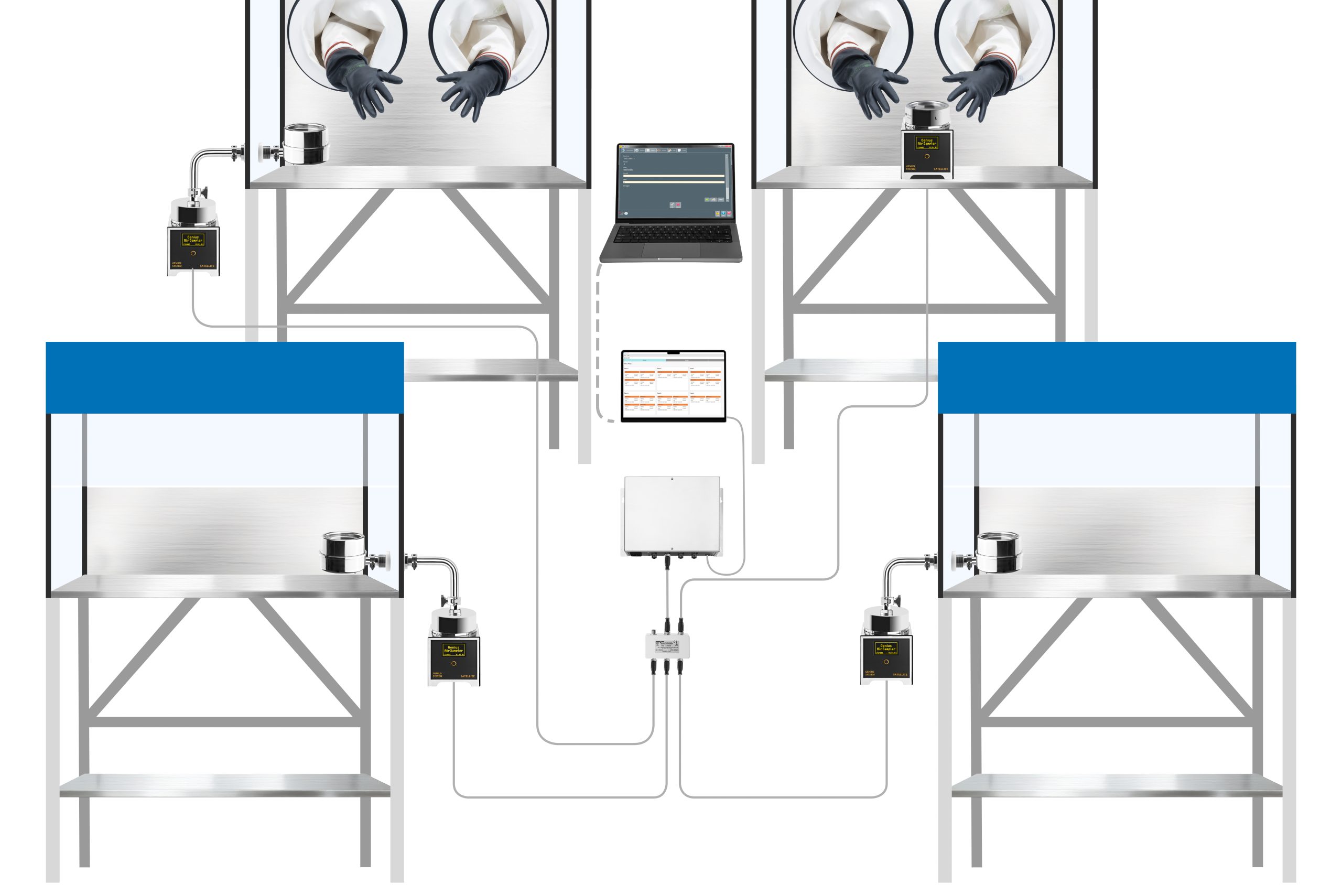
The GENIUS SYSTEM can be integrated into different cleanroom equipment configurations. The following examples show satellite positioning in systems with RABS isolators and biological safety cabinets (BSC).
 |
 |
|
| Example of a GENIUS SYSTEM configuration in two RABS isolators. The system consists of two GENIUS satellites and four GENIUS satellites with remote heads. | Example of a GENIUS SYSTEM configuration in two RABS isolators and two biological safety cabinets (BSC), consisting of one GENIUS satellite and three GENIUS satellites with remote heads. |
The GENIUS SYSTEM satellites can run at two different flow rates: 15 l/min or 25 l/min. Satellites with different flow rates can be used in the same system, with each satellite sampling different recipes. A different stainless steel aspirating head is required according to the flow rate: a one slit aspirating head at 15 l/min and a 180 holes aspirating head at 25 l/min.
Standard 90 mm plastic Petri dishes are used for sampling. For continuous sampling, Petri dishes containing at least 30 ml of agar media are recommended, as the increased volume of media helps prevent dehydration during long sampling cycles.
Sampling is based on the Andersen principle in accordance with ISO 14698. A known volume of air is directed onto the surface of a suitable sterile culture medium. Micro-organisms present in the air settle on the surface. After incubation for 24–72 hours, the resulting colonies are counted, and the result is related to the volume of air sampled. The result is expressed as colony-forming units per cubic meter of air (CFU/m³).
During long sampling periods, the agar media may dehydrate, affecting the recovery of micro-organisms and the reliability of results. The GENIUS SYSTEM provides two continuous sampling modes using the corresponding aspirating heads.
Choosing the sampling mode
The configuration depends on the duration of the critical operation and the monitoring requirements. At a flow rate of 25 l/min, sampling can be performed for up to 3 hours using one Petri dish. At 15 l/min, the rotating Petri dish allows sampling for up to 4 hours and makes it possible to identify the time interval in which contamination occurred according to the position of colonies on the agar. Since satellites with different flow rates can run in the same system, the configuration can be selected individually for each monitored area.
Continuous sampling for up to 3 hours at 25 l/min
At a flow rate of 25 l/min, each GENIUS satellite can sample for up to 3 hours without de-hydrating the media. The stainless steel aspirating head with 180 holes is used for this purpose. Sampling time depends on the selected volume. Typical sampling volumes are 100–300 l for standard conditions and environments with higher contamination levels, and 1000 l for cleanrooms with low contamination levels. The GENIUS SYSTEM sampling volume range is 30–6000 l.
The advantages are:
Continuous sampling for up to 4 hours at 15 l/min
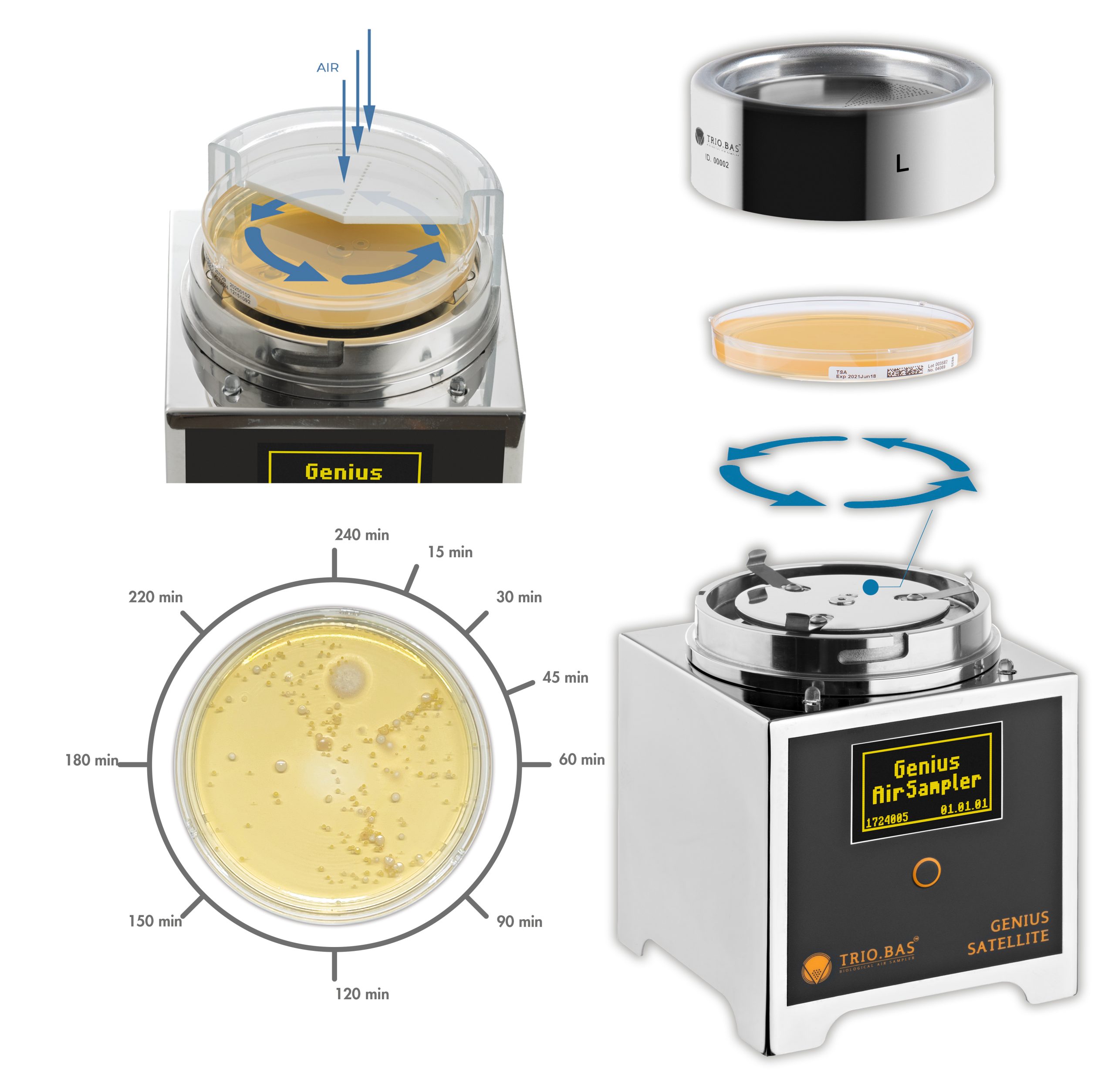
At a flow rate of 15 l/min, the stainless steel one slit aspirating head is used. During sampling, the head remains fixed while the Petri dish containing the agar media rotates by 360°, exposing new areas of the agar surface to the airflow. The rotation speed depends on the volume to sample. Under specific conditions, this configuration allows continuous sampling for up to 4 hours without de-hydrating the media.
The advantages of continuous sampling for up to 4 hours are:
During continuous monitoring over an eight-hour work shift, one sampling point using the sampling mode for up to 4 hours requires two Petri dishes. Compared with an air sampler that must be restarted and the plate replaced at the beginning of each new cycle, this approach reduces plate consumption and the number of personnel interventions.
Processing the aspirating head and housing
The stainless steel aspirating head is sterilized in an autoclave for 20 minutes at 121 °C. Sterile 70% isopropyl alcohol (IPA) is used to disinfect the head. In a cleanroom, the housing is wiped with a clean sterile cloth moistened with sterile 70% IPA. Under standard conditions, a solution of 80% alcohol in deionized water is used.
Recalibration is recommended after 12 months, or after 6 months in cases of intensive use or increased workload. When the specified interval is reached, the instrument displays a calibration reminder. If the calibration interval has expired, the sampling cycle can still be completed.
Both methods serve different purposes and can complement each other. Active sampling makes it possible to assess the viable microorganism concentration in a known volume of air. Passive monitoring using settle plates detects microorganisms that settle onto a surface over a defined period of time.
The GENIUS SYSTEM enables extended active sampling, but the need for passive monitoring is determined by the contamination control programme and risk assessment.
Yes. A single GENIUS SYSTEM can use satellites with flow rates of 15 and 25 l/min simultaneously, with an individual sampling recipe assigned to each satellite. The 15 l/min configuration uses a single-slit aspirating head, while the 25 l/min configuration uses a 180-hole aspirating head.
The choice of sampling mode depends on the duration of the critical operation and the monitoring requirements. At 25 l/min, sampling on a single Petri dish can continue for up to 3 hours. At 15 l/min, the rotating plate allows sampling for up to 4 hours and makes it possible to identify the time interval in which contamination occurred according to the position of colonies. The sampling mode is selected individually for each monitored area.
To continue monitoring after the four-hour cycle has ended, the Petri dish must be changed and a new sampling cycle started. Running sequential cycles allows monitoring to continue throughout the entire production process.
At a flow rate of 15 l/min, the aspirating head remains fixed while the plate containing the agar medium rotates. As a result, different areas of the agar correspond to different sampling time intervals. The position of a colony makes it possible to estimate when the microorganism reached the culture medium. The results can be correlated with personnel interventions, material movement and equipment-related events.
Yes. When a remote funnel is used, the culture plate housing is positioned outside the isolator, saving space inside and eliminating the need to handle the plate through the glove ports. Remote sampling options include the Remote Funnel System (code 181) and the Remote Head System for 90 mm Petri dishes (code 192).
Yes. The GENIUS SYSTEM can be integrated into existing isolators and RABS. The system features compact satellites with integrated pumps, connection via an M12 connector and the option of using remote aspirating heads.
Stainless steel satellites can remain in place during isolator decontamination with vaporized hydrogen peroxide (VHP). The aspirating chamber can also be sterilized with VHP in accordance with the equipment manufacturer’s recommendations.
The stainless steel aspirating head is sterilized in an autoclave for 20 minutes at 121 °C. Sterile 70% isopropyl alcohol (IPA) is used to disinfect the head. In a cleanroom, the housing is wiped with a clean sterile cloth moistened with sterile 70% IPA. Under standard conditions, a solution of 80% alcohol in deionized water is used.
The BAS Software (code 296) supplied as part of GENIUS SYSTEM configurations carries a conformance declaration to 21 CFR Part 11 requirements for electronic records and electronic signatures. Its features include user identification by username and password, access control according to user profiles, an audit trail of records, electronic signatures to confirm authorship, and the storage of data and results in protected files for report generation.
Yes. The CFU Photo Camera (code 337) connects to a PC running BAS Software. The software automatically saves photographs of the Petri dish immediately before and after manual colony-forming unit (CFU) counting. Detailed information about an individual sample can be exported to PDF or printed.
The satellites communicate via Modbus RS485. This protocol allows integration with laboratory information management systems (LIMS), building management systems (BMS) and supervisory control and data acquisition systems (SCADA) to be considered. The specific interface parameters are determined according to the platform used.
Recalibration is recommended after 12 months. Where use is intensive or operating conditions are demanding, the interval is reduced to 6 months. For continuous monitoring at a flow rate of 25 l/min, the published recommendation is the traditional annual control. Calibration determines whether an instrument produces accurate results within specified limits against a traceable standard over an appropriate measurement range. The instrument displays a calibration reminder when the set interval has elapsed. If the calibration interval has expired, the sampling cycle can still be completed.
Overview of the Genius System distributed measurement system configuration without a hub, with up to 4 satellites
Overview of the Genius System modular monitoring system configuration with 24 satellites
Overview of the 15 and 25 l/min satellite options for continuous microbiological air monitoring with the TRIO.BAS GENIUS SYSTEM
| Supply voltage: | 18-36 VDC |
| Consumption: | 500 mA for each satellite |
| Main connection: | M12-male-4 pins (for power supply and data connection) |
| Data connection: | Modbus RS485 |
| Graphic screen: | Clear OLED yellow, 34x62mm 128×64 pixels |
| Flow rate: | 15 l/min or 25 l/min |
| Volumes: | 30-6,000 litres |
| Plate: | Petri 90 mm |
| Rotating plate: | Only at 15 l/min, max 240 minutes |
| Filtered exhaust: | HEPA filter |
| Operating temperature: | 10°C-40°C |
| HR: | 0-85% |
| Certification: | CE mark |
| Model | Description | Availability | Price | Qty | Buy |
|---|---|---|---|---|---|
| 868K | GENIUS SATELLITE 15 l/m with one slit aspirating head Petri, cover head and connection cable 5 mt | Delivery time from 12 weeks | from 4 046$ |
-
+
|
|
| 869K | GENIUS SATELLITE 25 l/m with 180 holes aspirating head Petri, cover head and connection cable 5 mt | Delivery time from 12 weeks | from 4 046$ |
-
+
|
|
| 879 | PC TABLET with GENIUS SOFTWARE licence and one BAS SW licence | Delivery time from 12 weeks | from 7 331$ |
-
+
|
|
| 876 | Power supply 120W, 90-240 Vca | Delivery time from 12 weeks | from 364$ |
-
+
|
|
| 873/2 | Splitter for connecting max 2 satellite, 18-36 Vcc 100W | Delivery time from 12 weeks | from 331$ |
-
+
|
|
| 873/4 | Splitter for connecting max 4 satellite, 18-36 Vcc 100W | Delivery time from 12 weeks | from 408$ |
-
+
|
|
| 872 | Concentrator unit 110-230 Vca 4x100W with power supply and USB cable | Delivery time from 12 weeks | from 2 784$ |
-
+
|
|
| 877 | USB cable | Delivery time from 12 weeks | from 316$ |
-
+
|
|
| 878/5 | Connection cable 5 mt | Delivery time from 12 weeks | from 93$ |
-
+
|
|
| 878/20 | Connection cable 20 mt | Delivery time from 12 weeks | from 204$ |
-
+
|
|
| 878/25 | Connection cable 25 mt | Delivery time from 12 weeks | from 241$ |
-
+
|
|
| 830 | s/s 180 holes ASPI HEAD Petri | Delivery time from 12 weeks | from 427$ |
-
+
|
|
| 831 | s/s one slit ASPI HEAD Petri | Delivery time from 12 weeks | from 427$ |
-
+
|
You can request the necessary certificates, documentation, instructions and user guide for TRIO.BAS GENIUS SYSTEM using the special form.
You can buy TRIO.BAS GENIUS SYSTEM in UAE at a price starting from 4046 $ in «Texair FZCO» by leaving a request on the website, by phone +441225535040 or by email rop@texairmeasure.ae. TRIO.BAS GENIUS SYSTEM price are subject to change depending on exchange rates. We deliver instruments by transport companies in United Arab Emirates, Kuwait, Qatar, Saudi Arabia, Saudi Arabia, Bahrain and other Middle Eastern countries.